Sections
50 levels800 mWith props7.3 GB
The lightest way to play the city. Small levels load fast and keep the frame rate up; you switch level more often.
For: Lower-end PCs, and anyone who wants the best frame rate.
LosSantos_Sections
A map project by petergowild
The whole city, street for street at 1:1, as 68 levels you can skate in skate. with ReSkate: from the airport up to the Vinewood hills and from Del Perro Pier across to Mirror Park.
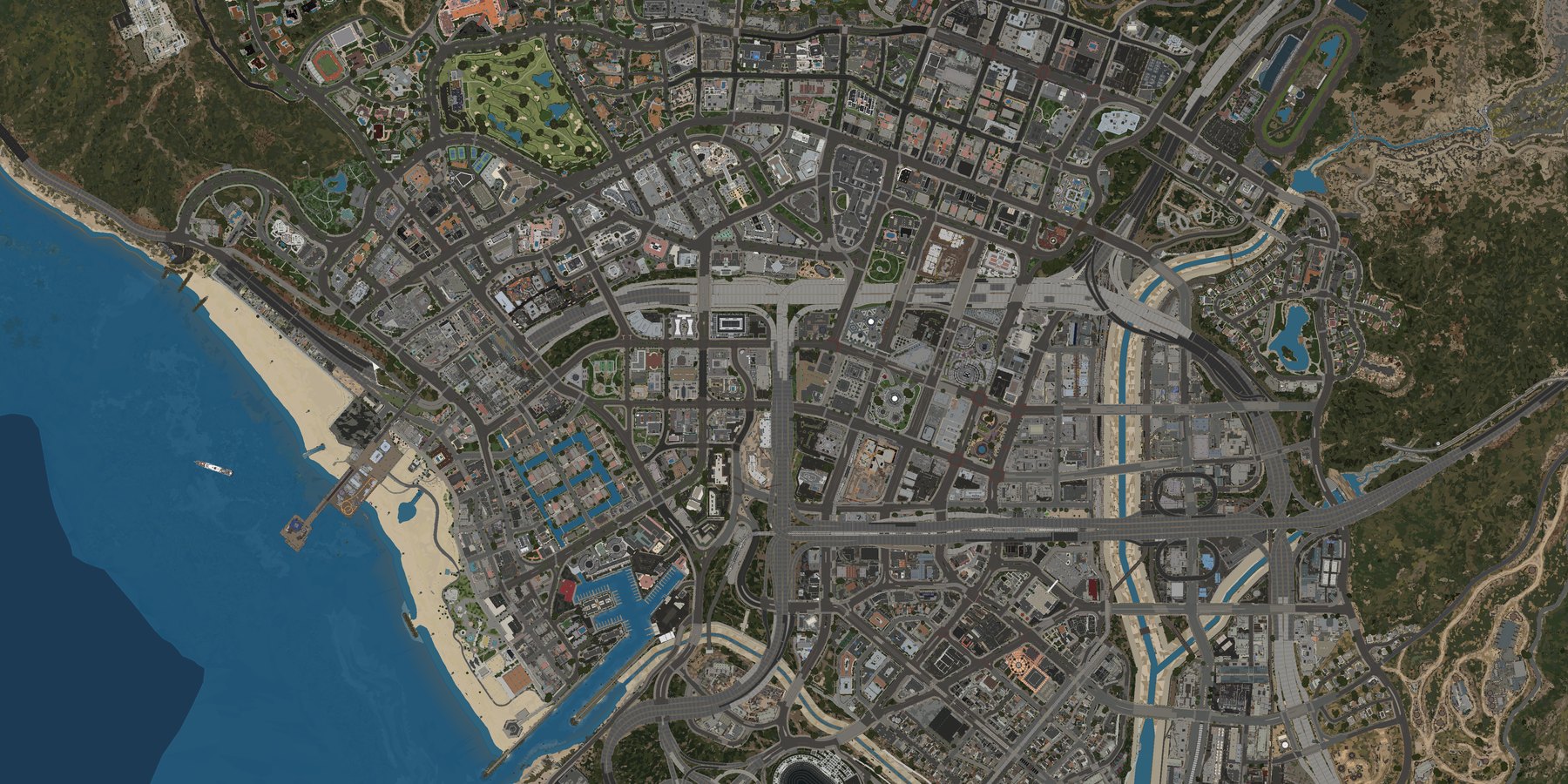
The city comes as three separate mods. They do not clash, so you can enable one, some or all of them.
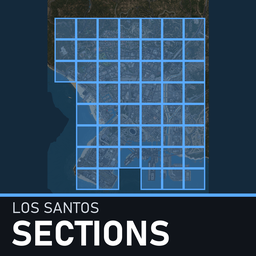
50 levels800 mWith props7.3 GB
The lightest way to play the city. Small levels load fast and keep the frame rate up; you switch level more often.
For: Lower-end PCs, and anyone who wants the best frame rate.
LosSantos_Sections
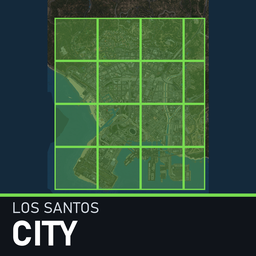
16 levels1.4 kmWith props5.3 GB
The same streets in fewer, larger levels: each one is four of the small squares put together.
For: Most players. Long lines with far fewer loading screens.
LosSantos_City
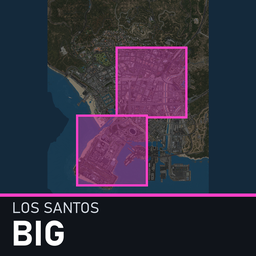
2 levels2 kmNo props1.2 GB
Two huge levels with the street clutter taken out: a clean canvas of buildings, plazas, ledges and stairs.
For: Building your own spots with the game's builder, planning trick lines, and cruising a long way.
LosSantos_Big
Coming soon
A combined map of GTA that brings the best-known skate spots of the city together in one place, built for servers, so a whole session can skate the highlights without changing level.
All of Los Santos does not fit in one skate. level. The game has a fixed number of texture slots (20,480, and about 8,000 are used by the game itself) and a fixed amount of memory for meshes. A single 2 km level of downtown with everything in it needed about 15,000 more textures and simply hung on loading.
So the city is cut into levels that each stay inside those limits. Bigger levels mean fewer loading screens, but more held in memory at once and a longer view to draw; smaller levels are the other way round. That trade is the whole reason there is more than one version.
| Mod | Level size | Props | What you gain | What it costs |
|---|---|---|---|---|
| Sections | 800 m | Yes | Fastest loading, best frame rate | More level switches |
| City | 1.4 km | Yes | Four times the area per level | Heavier; in the four densest levels the least visible textures are plain colours |
| Big | 2 km | No | The longest lines without loading | No street furniture; the heaviest levels |
Props are the loose street-level objects of the city: lamp posts, benches, bins, bollards, fences, signs, planters, and most trees and plants.
The streets as they really are, with everything standing where it stands in the original. Made for realistic skating: the spots are the ones the map gives you.
A clean canvas. Every building, road, plaza, ledge and staircase is still there, but the clutter is gone, which is also what lets a 2 km level fit. Made for dropping your own rails, ramps and objects with the game's builder, for planning trick lines, and for just messing around.
Every level is named by its place on a grid: a letter for the row (north to south), a number for the column (west to east), then the district. Click a map to see it full size.
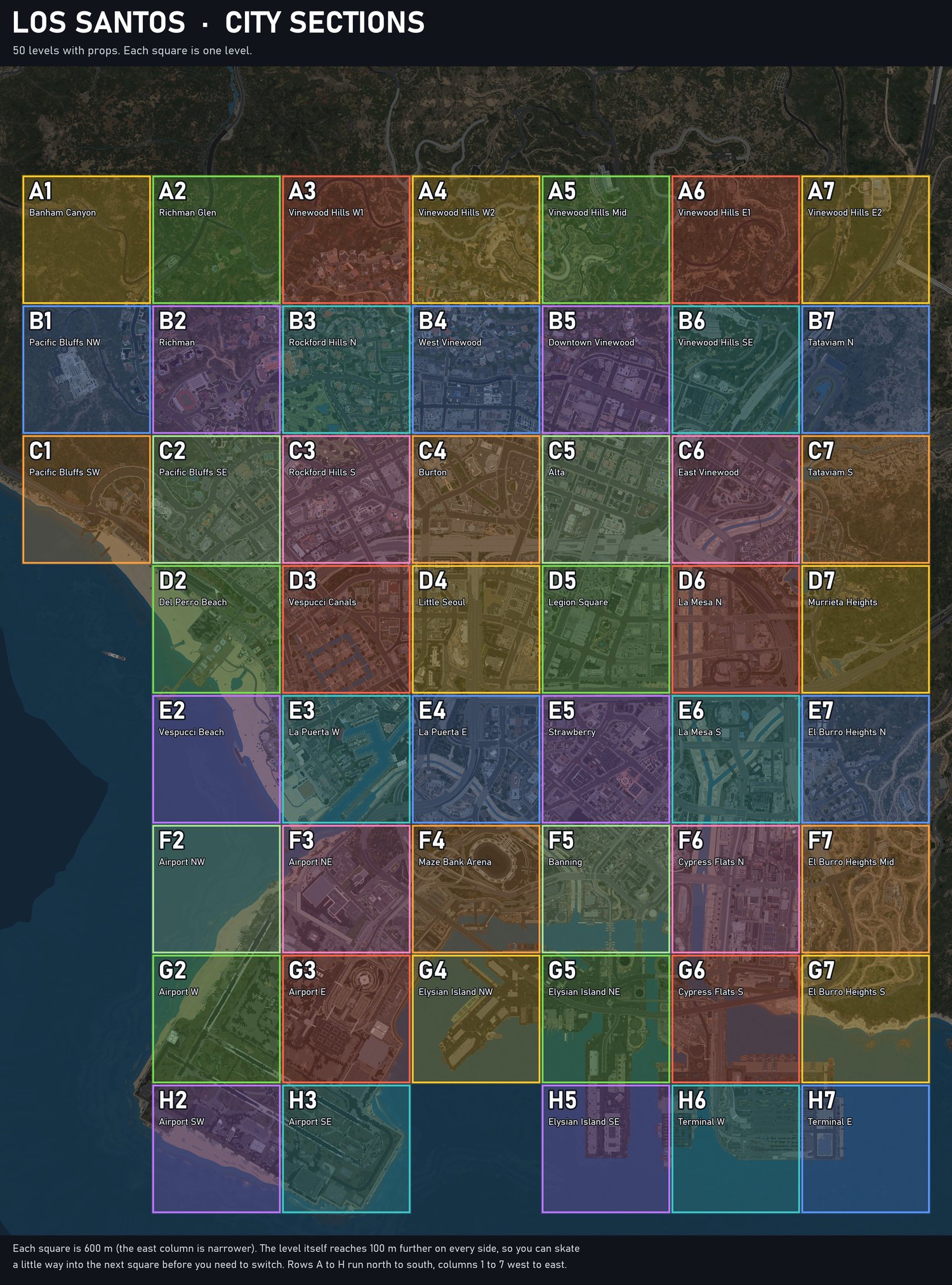
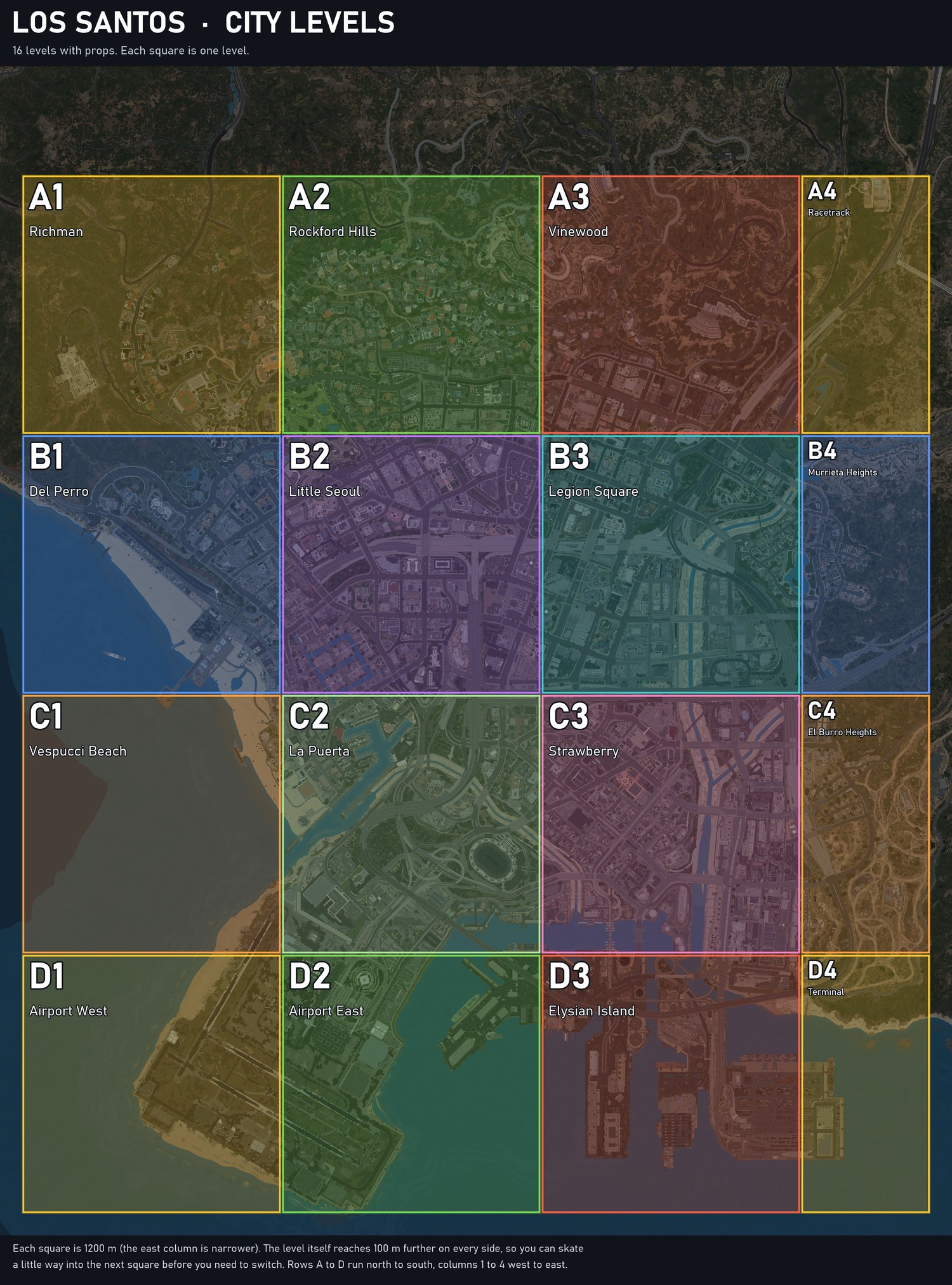
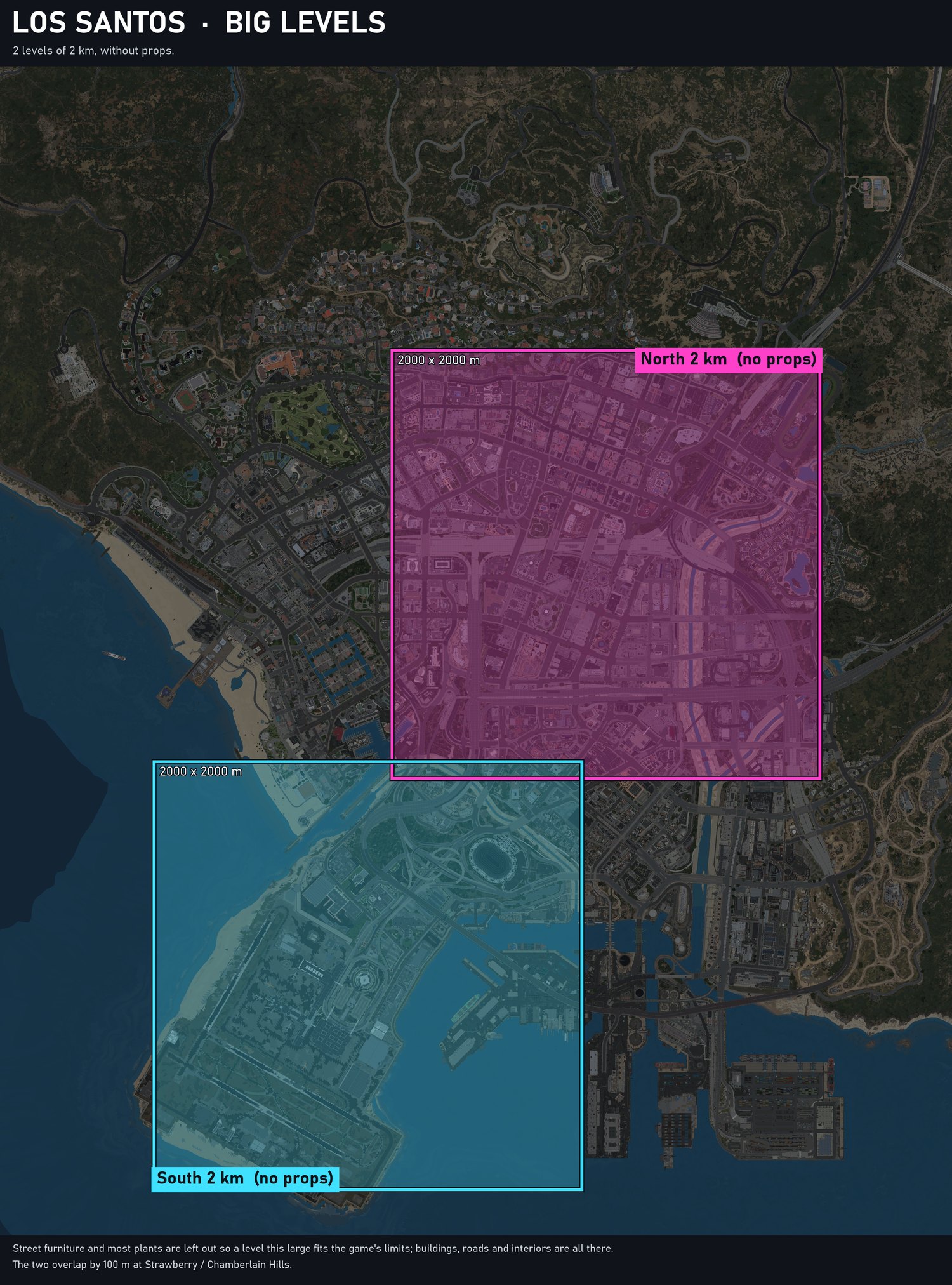
Neighbouring levels share a 200 m strip, so you can skate a little way into the next level before you need to switch.
Each level has fast-travel stops for the districts inside it, and one at the edge towards every neighbour, named after it (for example "to LS-C3 (south)").
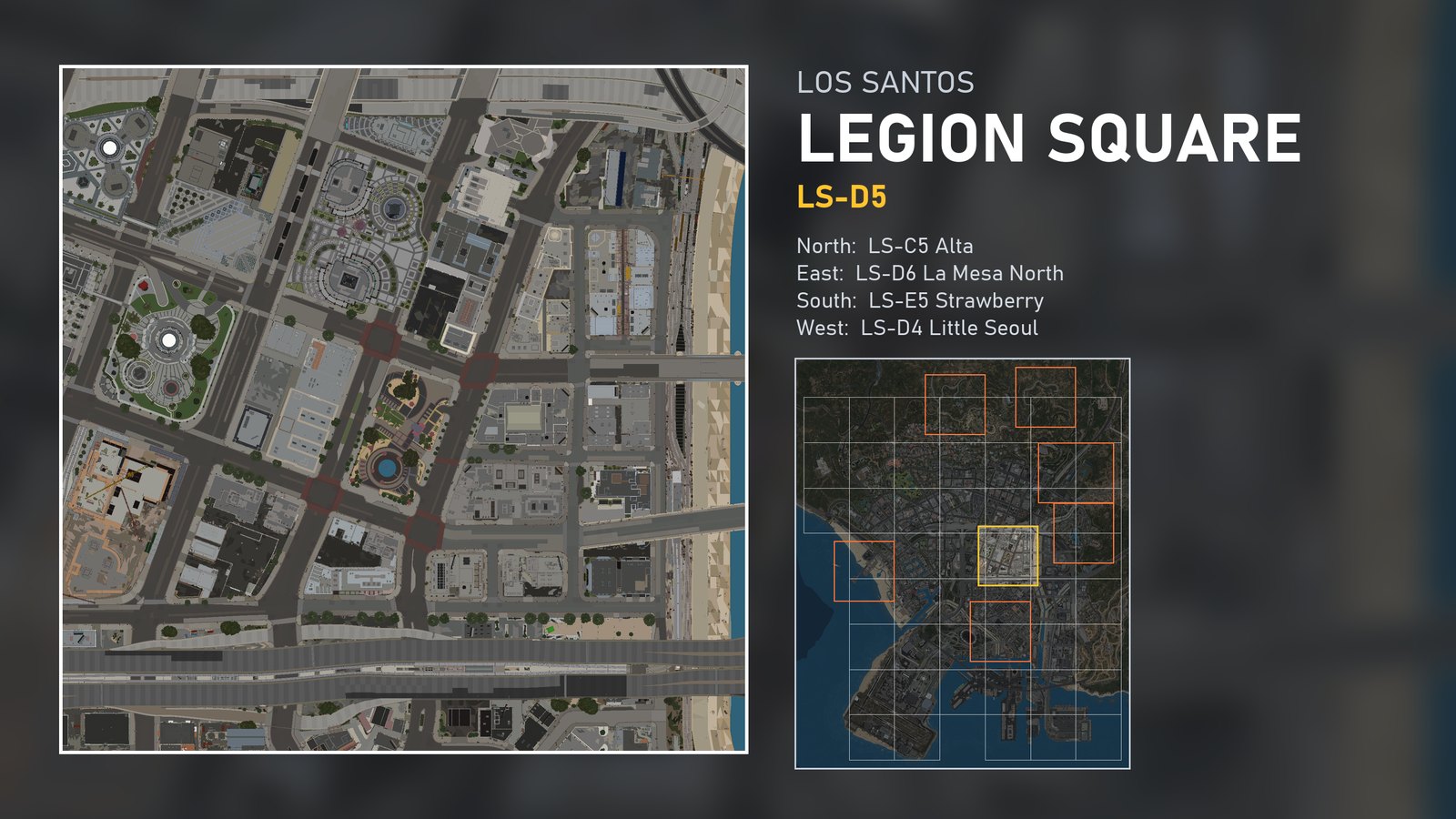
Each level's loading screen shows it from above with its name and where it lies in the city, and the pause menu has a map of the level.
The metro, tunnels, car parks and other interiors are in their real places, in every mod.
The levels are made by a set of open tools that read your own copy of GTA V and write ReSkate levels. Nothing from the game is in the repository: you point the tools at your install and they build the levels on your PC. That also means you choose the area, the size and the quality.
config.example.json to config.json and fill in where GTA V, skate., ReSkate Studio and your ReSkate Mods folder are, and a work folder with room to spare.
python lossantos.py check
python lossantos.py prepare
python lossantos.py build sections
python lossantos.py build city --only B3,C3
python lossantos.py build big
or a level of your own, anywhere on the map:
python lossantos.py level Pier --region -2000,-1700,-1200,-700 --spawn -1630,-1010
python lossantos.py pack city
python lossantos.py install LosSantos_City
A region is a box in the map's own coordinates, in metres: --region west,south,east,north. X grows to the east and Y to the north; Legion Square is at about (195, -934), the airport around (-1200, -2900), the Vinewood sign near (710, 1200). --spawn x,y is where you start; the tools put you on the nearest open road. The grid maps above are drawn in the same coordinates: the small squares are 600 m, starting at x = -2500 in the west and y = 1200 in the north.
| Option | What it does | Guide |
|---|---|---|
--region size | How much of the map is in one level | 800 m runs everywhere. 1.4 km is fine in most places and needs --max-textures downtown. 2 km needs --no-props as well. |
--no-props | Leaves out street furniture and most plants | A clean canvas, and a far lighter level. |
--no-interiors | Leaves out the metro, tunnels, car parks and shops | Saves textures where you do not need them. |
--textures 256 | Largest texture side in pixels | 256 is the default; 512 is sharper and about three times the size. |
--detail 1 | Which of the game's model versions is used | 0 is the best, 1 the default, 2 and 3 are lighter. |
--max-textures 5400 | Keeps the most visible textures and turns the rest into flat colours | The game has a fixed number of texture slots; about 5,400 per level is safe. The tools tell you how many a level has. |
--far-view 0.03 | How detailed the distant city is | 0.03 is light; up to 0.5 looks better on open ground and costs memory. |
There is also python lossantos.py model, which writes any region, or the whole map, as an ordinary glTF 3D model for other uses.
I'm petergowild. I built this over several days because I really love skate. and GTA, and I wanted to see the two together.
It was made partly with the help of Claude, Anthropic's AI assistant, which wrote the exporter and the build tools; the direction, the testing and the many rebuilds were mine.